Flat Roof Seam Repair in Costa Mesa, CA
Whether it’s a lifted membrane seam or a corroded fastener on a metal panel roof, seam failures are one of the most common — and most fixable — sources of flat roof leaks.
- TPO, PVC & EPDM seams
- Metal panel fasteners
- Modified bitumen seams
- Same-day diagnosis
Two Different Kinds Of Seam Failure
“Seam repair” actually covers two fairly different problems depending on what kind of roof you have, and it’s worth understanding the difference before assuming you know what’s wrong. On membrane roofs — TPO, PVC, EPDM, or modified bitumen — a seam is where two sheets of material are joined, either heat-welded, chemically bonded, or adhered with seam tape or cement. On metal panel roofs, the equivalent weak point is the overlapping seam between panels, held together with gasketed fasteners rather than a bonded joint.
Membrane Seam Separation
Membrane seams fail for a fairly predictable set of reasons: UV and heat cycling over years of Costa Mesa’s long dry season gradually breaks down the bond strength, foot traffic or wind uplift stresses a seam that was already marginal, or the original seam simply wasn’t welded or adhered correctly to begin with. Once a seam starts to lift even slightly, it tends to get worse — each cycle of expansion and contraction works the gap a little further open, and it eventually starts admitting water during rain.
Metal Panel Seam & Fastener Failure
Metal panel roofs use overlapping panels sealed with a gasket, held down with hex-head fasteners that have a rubber or neoprene washer underneath. Over time — especially with Costa Mesa’s daily marine-layer moisture cycle — that washer deteriorates and the fastener itself can begin to corrode. Once that happens, water works its way in at the fastener point, gets trapped between the overlapping panels by the seam’s own gasket, and eventually drips through at a different spot than where it entered. The rust that forms from trapped moisture then works its way to the surface, which is often the first visible sign something’s wrong.
How We Repair Each Type
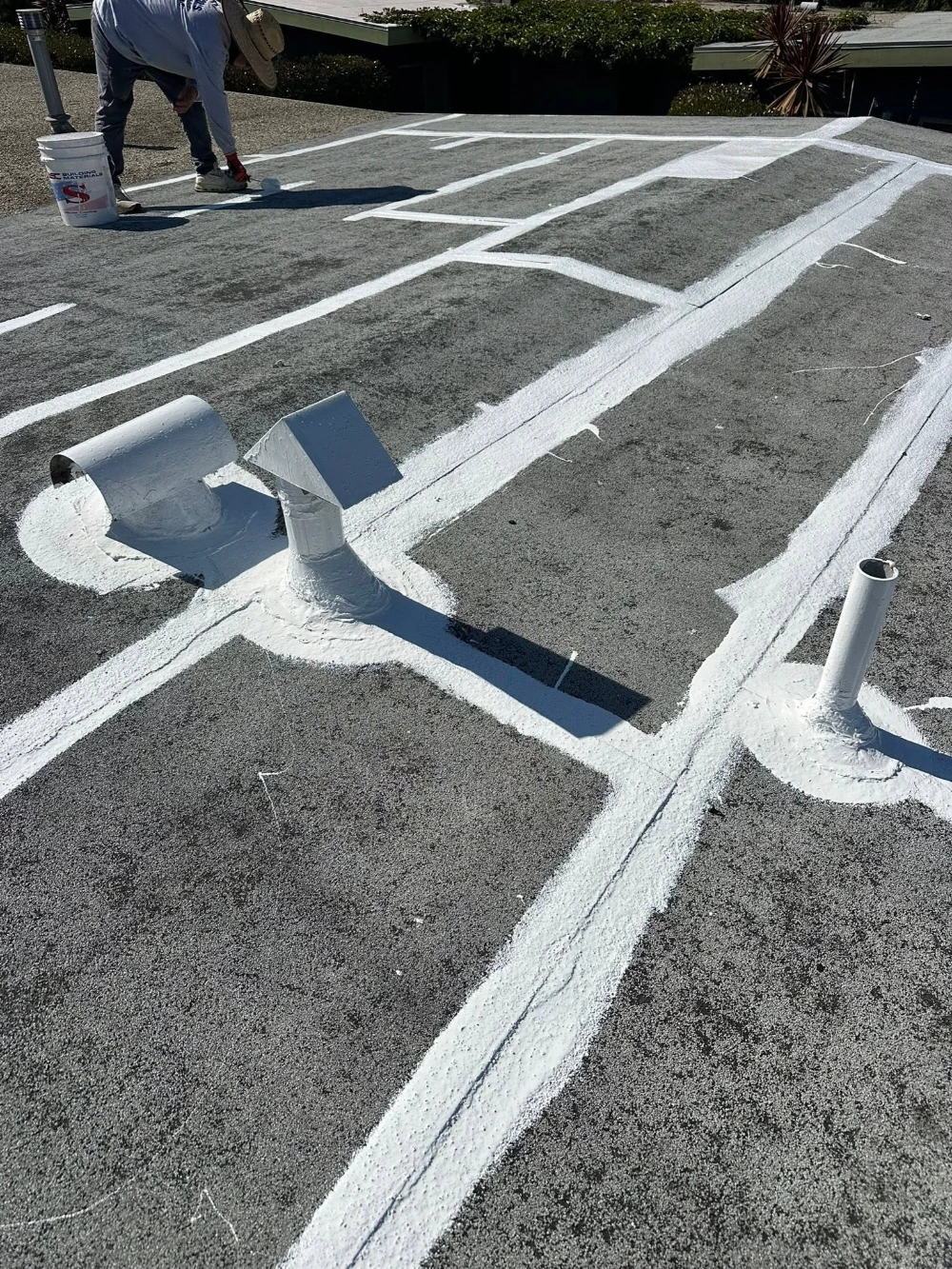
Membrane Seam Repair
Clean and prep the separated area, then reseal or re-weld the seam with a reinforcing fabric strip embedded for real strength — not just sealant alone.

Metal Panel Repair
Remove corroded fasteners, clean rust from the exposed metal, re-fasten through new holes, then seal the full seam with a silicone and mesh system so it won’t rust again.

Compatibility Check
We confirm any repair material is actually compatible with your existing roofing system before applying it — mismatched materials are a common cause of repairs that fail again quickly.
Why Seam Repairs Get Botched So Often
We get called out fairly regularly to fix a seam that’s already been “repaired” once, usually with generic caulk or a sealant that isn’t rated for the specific membrane material involved. Caulk isn’t designed to handle the constant expansion and contraction a roof seam goes through across a full year of Costa Mesa’s dry-to-wet cycle, and it typically fails again within a season or two — sometimes faster. A proper seam repair uses a reinforcing membrane strip embedded into compatible flashing cement or a heat-weld, not a bead of caulk run along the gap.
On metal roofs specifically, reusing the same fastener holes when re-securing a panel is another common shortcut that leads to repeat failures — the original holes are already compromised, and driving a new fastener into the same spot doesn’t create a fresh, reliable seal the way a new hole does.
Lifted Seam Or Rust Stains Showing Through?
Both are fixable — but only if the repair addresses the actual cause instead of just covering it.
How Seam Problems Show Up Differently Indoors
A failing membrane seam and a failing metal panel seam tend to produce different symptoms inside the building, which is actually a useful diagnostic clue before anyone even gets on the roof. Membrane seam leaks are often associated with a gradual, spreading stain that seems to track along a line — following the direction of the seam itself as water travels along the gap before finding a spot to drip through. Metal panel fastener leaks more often show up as a series of small, closely spaced rust-tinged spots, since each affected fastener is its own potential entry point along the seam.
Knowing which pattern you’re dealing with before we arrive helps speed up the diagnosis, though we always confirm with a physical inspection rather than relying on the indoor pattern alone — the two can look similar in early stages, and getting the diagnosis right the first time is what keeps a seam repair from needing to be redone.
When A Seam Issue Signals A Bigger Problem
An isolated seam failure on an otherwise sound roof is usually a straightforward, contained repair. Multiple seam failures across different areas of the same roof, especially on a membrane approaching or past its expected lifespan, can be a sign of broader material fatigue rather than one localized issue — and in that situation, we’ll tell you honestly if a section replacement makes more sense than repeatedly patching individual seams as they fail one after another.
Frequently Asked Questions
Can a lifted membrane seam be repaired without replacing the whole roof?
Yes, in most cases. A localized seam repair — cleaning, resealing, and reinforcing the affected joint — can resolve the leak without touching the rest of the membrane, as long as the surrounding roof is in reasonable overall condition.
Why does my metal roof have rust stains but I can’t find a hole?
Rust often forms at a corroded fastener where the washer underneath has deteriorated, letting water in at that point. The rust then works its way to the surface and can appear some distance from where the water is actually entering, which is why it’s easy to miss the real source.
Is caulk an acceptable fix for a roof seam?
Not as a standalone, long-term fix. Caulk doesn’t handle the ongoing expansion and contraction a seam goes through and typically fails again within a season or two. A proper repair uses a reinforcing membrane strip embedded in compatible cement or a heat-weld matched to the existing material.
How do I know if my roof has TPO, PVC, or EPDM seams?
They look and feel different — TPO and PVC are typically a single-ply sheet with heat-welded seams, while EPDM is a black rubber membrane usually joined with seam tape or adhesive. If you’re not sure, we identify it during the inspection at no extra step.
How long does a seam repair last?
A properly done seam repair, using compatible materials and reinforcement, should last as long as the surrounding roof section — often many years. A repair done with the wrong material or without reinforcement commonly fails within one to two seasons.