Can You Fix A Flat Roof Leak Yourself?
Sometimes, yes. We’d rather tell you that honestly than talk you into a service call you don’t need — and tell you plainly when it’s genuinely a job for a licensed pro.
- Honest DIY guidance
- No pushy upsells
- Costa Mesa, CA
What A Reasonably Handy Homeowner Can Try
If you’ve found a small, clean puncture on an accessible, flat section of membrane — a spot where you can safely stand, see the damage clearly, and reach it without a ladder onto a steep or dangerous area — a basic patch is genuinely within reach for someone comfortable with simple home repairs. The general process involves cleaning the area of loose debris and old sealant, priming the surface if needed, applying a compatible mastic or sealant in a thin, even layer, embedding a piece of reinforcing fabric into it, and covering with a second thin coat once the first has set.
The keys to a DIY patch actually holding are using a product genuinely compatible with your existing roofing material, applying it thin rather than thick (a thick application is more likely to crack and peel later), and doing it on a dry, mild day rather than right before or during a storm. If you’re not sure what material is on your roof, that’s worth confirming before buying anything — the wrong product can fail to bond or even damage the surrounding membrane.
When It’s Genuinely A Job For A Professional
Where DIY Stops Making Sense
- Flashing, parapet walls, or termination bars — these involve wall transitions and mechanical fasteners that need a proper flashing system, not a surface patch
- Anything on a commercial or multi-tenant roof, where a bad patch can affect a warranty or create liability beyond your own property
- Seam repairs on TPO, PVC, or metal panel systems, which typically require heat-welding or specific compatible materials most hardware stores don’t carry
- Ponding water or drainage issues — these are structural or slope problems that a surface patch doesn’t fix and can even make harder to properly diagnose later
- Any leak you can’t clearly and safely access, or one large enough that a failed DIY attempt would mean significantly more water damage
There’s also a warranty and insurance angle worth knowing about. If your roof is still under a manufacturer or workmanship warranty, DIY repairs using non-approved materials can sometimes void that coverage — worth checking before you start. And if you’re planning to file an insurance claim for storm or wind damage, having a licensed contractor document the damage before any repair work happens generally makes for a stronger, more straightforward claim than photos of a repair you’ve already made yourself.
Why We’re Telling You This Instead Of Just Booking A Call
We’d rather earn your trust with an honest answer than push a service call for a five-minute fix. If it turns out to be more involved than expected once you’re up there, or if the patch doesn’t hold, we’re happy to take a look — but plenty of small, well-diagnosed leaks genuinely don’t need a truck to show up. Being straight about that is part of how we operate, not an exception to it.
Good DIY Candidate
Single small puncture, flat accessible area, you know the roofing material, mild dry weather.

Call A Pro
Flashing, parapet, seams, drainage, commercial roofs, or anywhere you can’t safely and clearly assess the damage.

Not Sure Which?
Send us a photo or description — we’ll tell you honestly which category it falls into before you buy anything.
Not Sure If This One’s A DIY Job?
Tell us what you’re looking at — we’ll give you an honest answer, not an automatic sales pitch.
Tools And Materials For A Basic Membrane Patch
If you’ve confirmed your situation is a genuinely reasonable DIY candidate — a small, accessible puncture on a flat, safe section — the basic tool list is short: a stiff brush or broom to clear debris, a compatible mastic or sealant for your specific membrane type, a piece of reinforcing fabric (sometimes called webbing or fleece) cut a few inches larger than the damaged area on all sides, and a trowel to apply the material evenly. Gloves and eye protection are worth having on hand too.
Weather matters more than people expect. Roofing sealants need a dry surface and typically a minimum temperature to cure properly — applying anything to a damp membrane, or right before rain is forecast, is one of the more common reasons a reasonable DIY attempt still fails. Costa Mesa’s long dry season actually works in your favor here; there’s rarely a shortage of good patch-repair weather between April and November.
What A Good Patch Looks Like When You’re Done
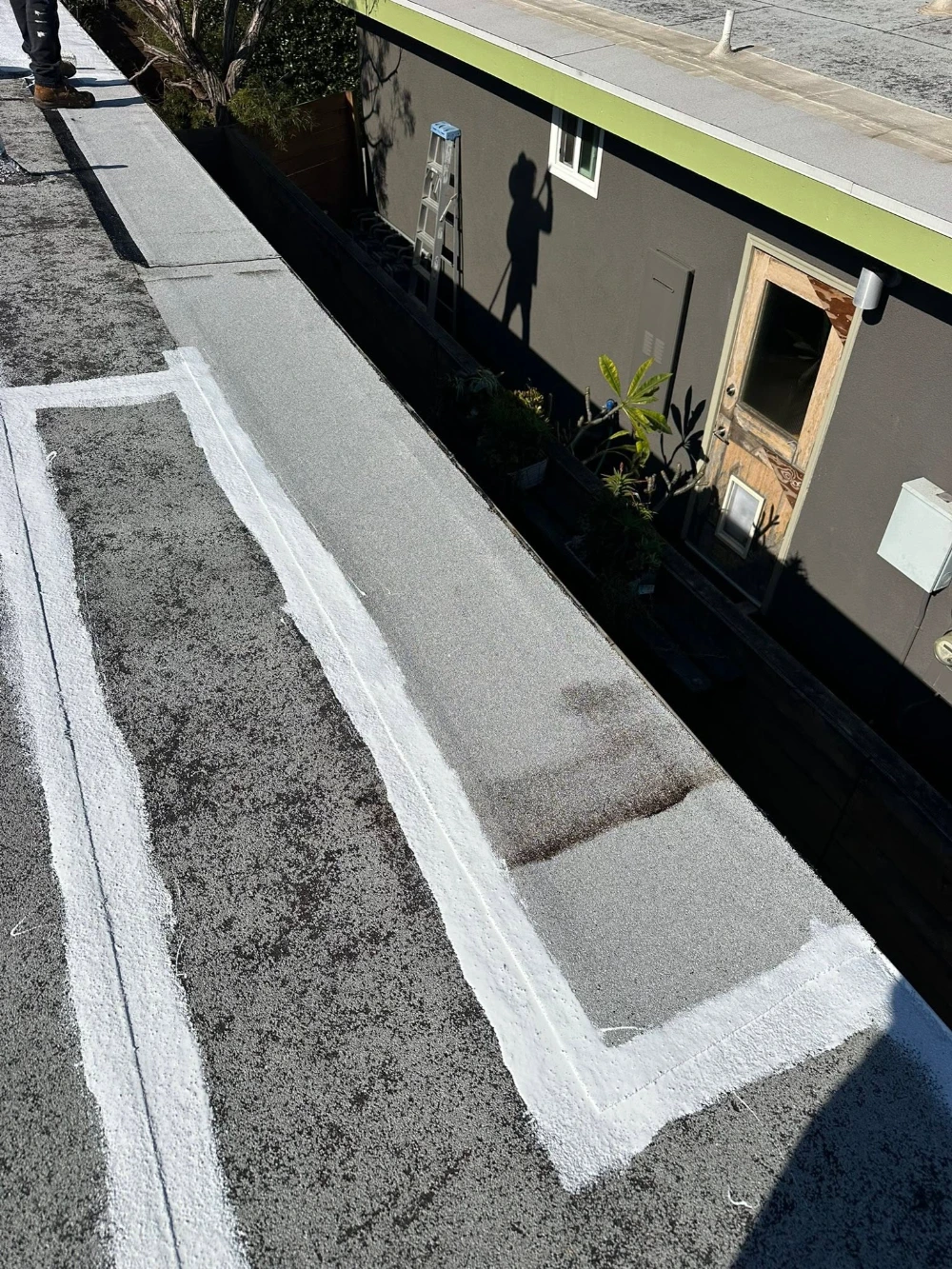
The finished patch should be smooth, thin at the edges (feathered down rather than ending in a thick ridge that can peel), fully covering the reinforcing fabric with no visible gaps or exposed fibers, and free of trapped air bubbles underneath. If it looks lumpy, thick, or like the fabric isn’t fully embedded, it’s worth redoing that section before calling it finished — a patch that looks rushed usually performs like one.
Frequently Asked Questions
Can a handyman fix a roof leak?
For a small, accessible membrane puncture, sometimes. For flashing, parapet transitions, seams, or anything on a commercial roof, you generally want someone who works specifically on low-slope roofing systems — general handyman repairs are a common source of the botched prior repairs we get called out to fix.
What roofing material should I use for a DIY patch?
It needs to match what’s already on your roof — asphalt-based products for built-up or modified bitumen roofs, and specific compatible materials for TPO, PVC, or EPDM single-ply systems. Using the wrong product is one of the most common reasons a DIY patch fails within a season.
Will a DIY repair void my roof warranty?
It can, depending on the manufacturer or workmanship warranty terms — many require repairs to use approved materials or be performed by a licensed contractor to keep the coverage intact. Worth checking your warranty paperwork before attempting a repair yourself.
Is it OK to use roofing caulk for a quick fix?
As a genuinely temporary measure to slow a leak until it can be properly repaired, caulk can buy you a little time. As a permanent fix, it typically fails within a season or two because it doesn’t handle the ongoing expansion and contraction a roof surface goes through.
How do I know if my leak is too big for a DIY fix?
If you can’t clearly see and safely reach the damage, if it involves a wall, vent, drain, or seam rather than an open flat section, or if the interior damage is already extensive, it’s past the point where a simple patch is likely to solve the problem — that’s when it’s worth a proper inspection.